
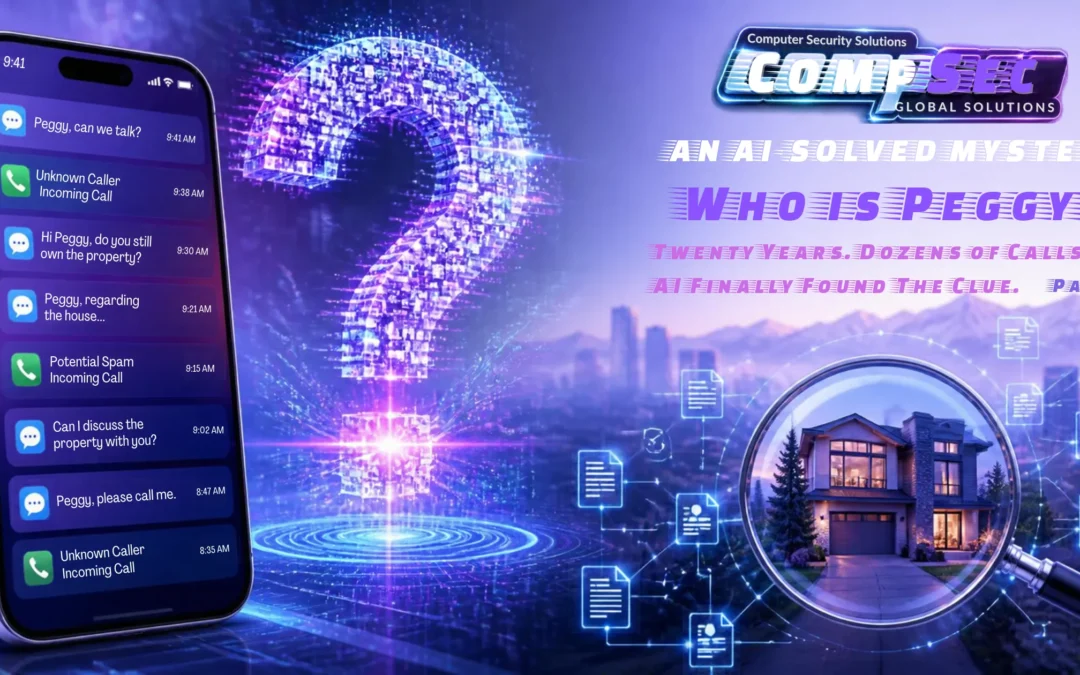
When AI Solved a 20-Year Mystery: Why People Kept Calling Me Looking for Peggy
For more than twenty years, I've had the same cellphone number.
For almost that entire time, I've periodically received phone calls asking for someone named Peggy.
Sometimes the caller would simply ask:
"Is Peggy available?"
Other times:
"Could I speak with Peggy please?"
In the early days, I assumed it was just a wrong number.
After all, everybody receives occasional calls intended for someone else.
For the first few years, my response was polite and simple:
"Sorry, you have the wrong number."
As the calls continued, I started adding more context.
"I've had this number for years, and to my knowledge, nobody named Peggy has had it during that time."
Recently, after receiving yet another call, my response had evolved into:
"I've had this number for more than twenty years. I don't know a Peggy, I've never been Peggy, and I have no connection to anyone named Peggy. Please remove me from your list."
Yet the calls continued.
The Mystery Gets Stranger
Then something changed.
The text messages started.
Unlike the phone calls, the text messages contained useful information.
Specifically, they repeatedly referenced the same property address.
That immediately raised a series of questions.
- Was this some kind of scam?
- Was somebody attempting a phishing attack?
- Was the address real?
- Was the address connected to Peggy?
- Were the calls and text messages related?
- Why was my phone number involved?
- Was there any way to stop it?
The more messages arrived, the more curious I became.
Eventually a thought occurred to me.
This seemed like the kind of mystery artificial intelligence might be able to help solve.
Putting AI To Work
Like many people, I use AI regularly for business purposes.
It helps draft emails, summarize information, explain technical concepts, and accelerate research.
But what if it could do something more interesting?
What if it could help connect clues scattered across multiple sources of information?
So I opened Microsoft Copilot and started asking questions.
Question #1: Is The Address Real?
Yes.
The property exists.
It is located in the Denver metropolitan area.
Question #2: Is It Connected To A Real Person?
Again, yes.
Publicly available information appeared to connect a real individual named Peggy to the property.
Additional records also showed a trust containing the same name.
At this point, the pattern became more interesting.
The callers wanted Peggy.
The text messages referenced a property associated with Peggy.
This was no longer feeling like random chance.
Question #3: Why Was My Phone Number Attached To Any Of This?
This is where things became fascinating.
The traditional search approach had taken me only so far.
AI, however, excels at identifying patterns that humans might overlook.
As more records were examined, a surprising clue emerged.
A public voter registration record contained a district identifier.
Normally, that would be just another piece of administrative data.
Most people would never look at it twice.
But something stood out.
A large portion of the digits contained within that identifier matched a substantial portion of my cellphone number.
Not perfectly.
Not continuously.
But enough of the digits appeared in the same sequence that it immediately attracted attention.
In fact, approximately sixty percent of the digits from my number appeared within the identifier, separated by unrelated digits.
The probability of such a pattern appearing by chance seemed low enough to warrant further investigation.
A New Theory Emerges
At this point I began considering an alternative explanation.
What if Peggy never had my phone number?
What if this wasn't a case of recycled phone numbers at all?
What if a database somewhere contained corrupted information?
Perhaps a field had been mapped incorrectly.
Perhaps information from one column had accidentally been copied into another.
Perhaps a bad import, synchronization error, or data conversion issue had occurred years ago.
And perhaps that bad data had subsequently been copied from database to database, organization to organization, and list to list.
If that happened, it could explain why callers from completely unrelated organizations kept reaching my number while attempting to contact the same person.
For the first time in more than twenty years, I had a plausible explanation.
The Bigger Lesson
Most discussions about artificial intelligence focus on content creation, email drafting, or automation.
Those are certainly useful applications.
But one of the most valuable capabilities of AI is its ability to help identify relationships between seemingly unrelated pieces of information.
In this case, AI wasn't generating content.
It was helping investigate a mystery.
It was helping connect data points.
It was helping identify patterns that might have otherwise remained hidden indefinitely.
Whether this ultimately proves to be a database corruption issue, a data aggregation error, or another type of record mismatch remains to be seen.
But after two decades of unanswered questions, the investigation finally has a direction.
Coming In Part 2
The story isn't over.
In Part 2, we'll dive deeper into the likely source of the bad data, how information spreads through marketing databases, whether there are legal remedies available for persistent unwanted contacts, and whether it may be possible to finally stop the calls and texts.
After more than twenty years, we may finally be getting close to answering the question:
Who is Peggy, and why do so many people think I have her phone number?